

What drives euro area consumers to Chinese e-commerce platforms
13 July 2026
By Maria Dimou, Maarten Dossche, Teresa Hütten, Georgi Kocharkov and Omiros Kouvavas
Chinese e-commerce platforms have become increasingly popular in the euro area. An ECB survey shows that shoppers are attracted by low prices and a wide product range. However, concerns about quality, trust and environmental consequences deter non-users.
Platforms such as Temu, Shein, AliExpress have rapidly expanded in European consumer markets. These platforms focus on a wide range of predominantly low-cost consumer goods. From 2023 to 2024, shipments of low-value items from China more than doubled, raising key policy questions. Who uses these platforms and why? What do they buy? What shapes their choices? The ECB’s April 2026 Consumer Expectations Survey (CES) sheds light on these questions, pointing to three main findings:
- Chinese e-commerce platforms are widely used across the euro area;
- customers are primarily attracted by low prices and the wide variety of products, especially in categories such as clothing, household goods and electronics;
- non-users are mainly discouraged by concerns about quality and trust, while geopolitics appear to play only a limited role in consumers’ decisions.
Chinese e-commerce platforms are widely used across the euro area
According to the European Commission’s E-commerce communication, in 2024 around 90% of all e-commerce shipments entering the EU with a value of up to €150 came from China. Their volume more than doubled, rising from 1.9 billion items in 2023 to 4.17 billion items in 2024. The Commission links this development to the exponential growth in the EU customer base of Chinese online retailers such as Temu and Shein in the course of 2024.
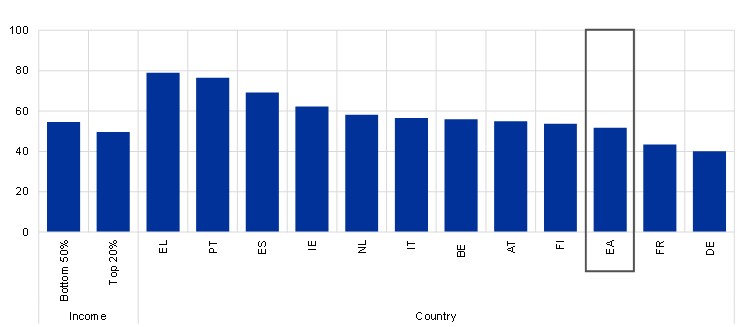
More than half of the CES respondents reported having used Chinese e-commerce platforms.[1] But usage varies considerably across countries and income groups (Chart 1). The popularity of Chinese platforms is highest in Greece, Portugal and Spain, where more than 70% of consumers reported shopping on these platforms. Meanwhile, usage is lowest in Germany and France, where they are used by less than 50% of consumers. The particularly deep market penetration in southern Europe points to striking cross-country differences in consumer habits, platform awareness, delivery infrastructure, trust and local retail alternatives.
Indeed, the survey shows that use is more common among lower and middle-income households. This is consistent with the strong role of affordability: consumers facing tighter budget constraints may be especially responsive to low price offers. That said, many higher-income households also shop on Chinese platforms.
Chart 1
Use of Chinese e-commerce platforms across countries and income groups
(percentage of respondents)
Sources: ECB Consumer Expectations Survey and ECB staff calculations.
Notes: Shares of respondents are weighted by the survey weights. “Bottom 50%” and “Top 20%” include those respondents whose income is below the median or above the 80th percentile of the distribution within each wave of the CES and within each country. “EA” refers to the euro area. The data were collected in April 2026.
Low prices and variety shape shopping decisions
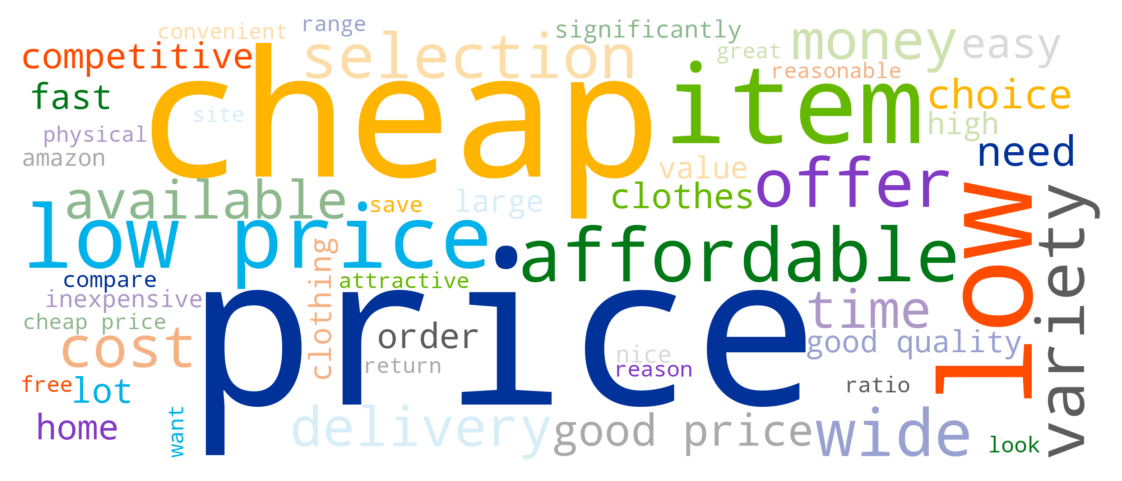
The survey also asked frequent users to explain, in their own words, why they shop on these platforms.[2] Price considerations clearly dominate the open-text responses. Words such as “price”, “cheap” and “cheaper” come up most often in survey responses (Chart 2). This underscores the central role of affordability. So, for many consumers these platforms seem to be a way to stretch household budgets, as the cost of living remains a concern. Inflation in the euro area has returned to a moderate level since its peak in 2020-21 and is currently stable. However, consumers still appear to compare prices closely and seek cheaper alternatives.
However, a second major driver is product variety. As the survey results show, consumers value the broad range of products on offer, including niche items, accessories and goods that may be difficult to find in local shops. In sum, low prices combined with extensive product choice appear to be the core competitive advantage of these platforms.
Chart 2
What drives frequent purchases?
(terms are assigned a font size proportional to their frequency)
Sources: ECB Consumer Expectations Survey and ECB staff calculations.
Notes: The word cloud for frequent buyers is based on open-text responses from respondents who reported purchasing products from Chinese e-commerce platforms at least a few times a year. These data were collected in April 2026.
What do consumers buy and how often?
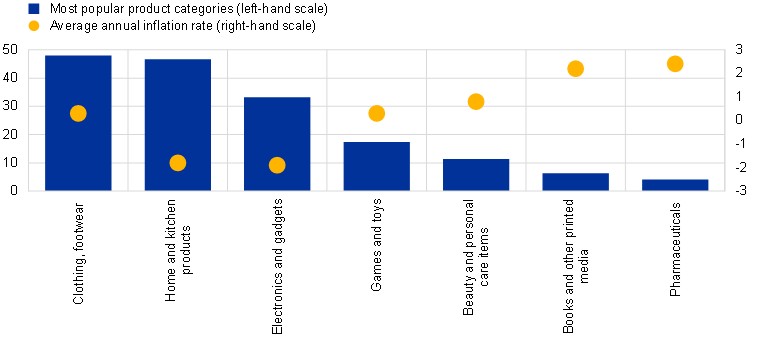
So, what do customers look for? The CES asked consumers directly.[3] Euro area consumers most often turn to Chinese e-commerce platforms for clothing, household goods and electronics – areas where shoppers tend to be particularly price-sensitive (Chart 3). The vast majority of orders are of small value: almost two-thirds are worth no more than €25 and 90% are up to €50. Moreover, one in five respondents reported shopping at least once a month on these platforms. Taken together, these results once more underscore the price-driven purchasing behaviour. In fact, for many of the categories of goods most frequently purchased through these platforms, average inflation over 2025 was negative or close to zero. This pattern is also consistent with the idea that low-cost imported goods may have helped keep a lid on prices for some types of consumer products.
Chart 3
Most commonly purchased product categories and price dynamics
(left-hand scale: percentage of respondents; right-hand scale: annual percentage changes)
Sources: ECB Consumer Expectations Survey, Eurostat, and ECB staff calculations.
Notes: The blue bars show the share of respondents who reported purchasing each product type, weighted by the survey weights. The yellow markers show the corresponding average HICP inflation rate over 2025 for each product category. The data were collected in April 2026.
What deters consumers?
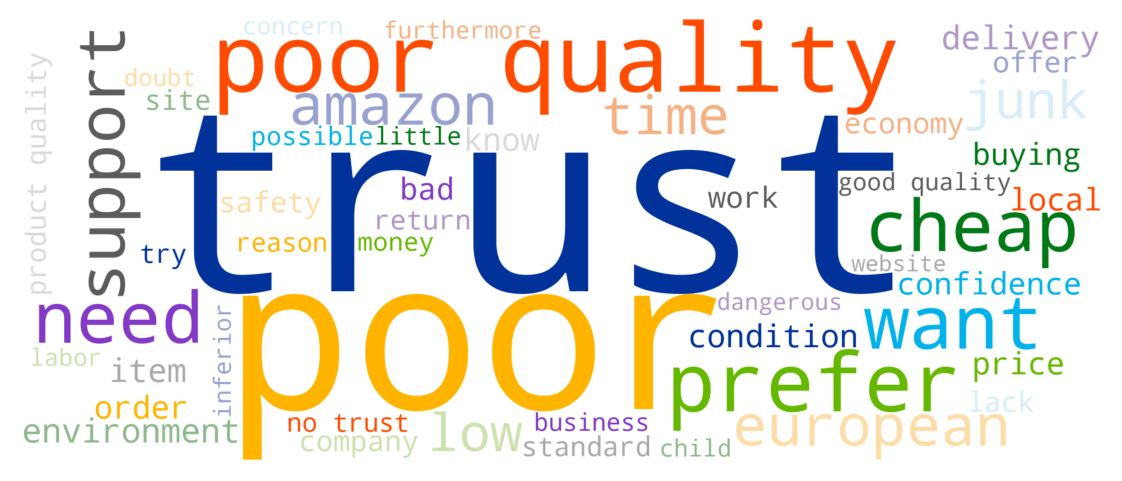
Despite these selling points, almost half of the CES respondents indicated they didn’t use Chinese platforms. Non-users indicated being put off by concerns about low perceived product quality, trust, and environmental impact (Chart 4). Many respondents associated goods sold on these platforms with uncertainty about quality, e.g. durability and reliability. For them, low prices did not outweigh concerns that products might not meet expectations. Respondents also mentioned concerns about personal data security, payment safety, customer service and the reliability of platforms. These concerns may be particularly relevant for consumers who have limited experience with cross-border online shopping or who are wary of how their personal information may be used. Environmental concerns also featured prominently, with some respondents worrying about the environmental impact of long-distance shipping, excessive packaging, returns and sustainable production. These concerns may discourage purchases even when prices are attractive. Finally, non-users also frequently expressed a preference for buying European products, and a desire to support local or regional businesses and protect European jobs. Some non-users also mentioned a preference for purchasing goods they perceive as being produced under higher regulatory, labour or environmental standards.
Chart 4
What deter consumers from buying?
Sources: ECB Consumer Expectations Survey and ECB staff calculations.
Notes: The word cloud for non-users is based on open-text responses from respondents who reported that they had never purchased products from Chinese e-commerce platforms. The data were collected in April 2026.
Geopolitics do not seem to deter many consumers
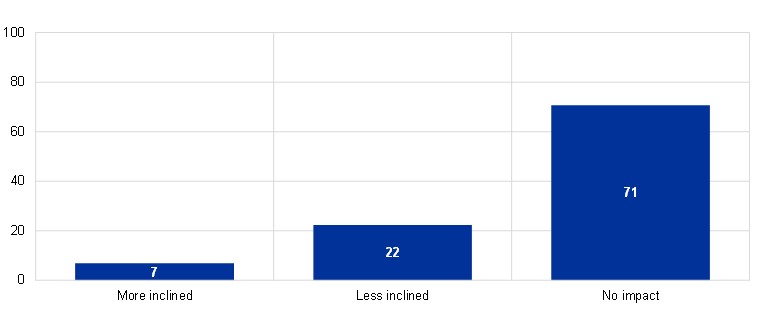
There is evidence that the recent geopolitical tensions have been affecting consumer choices.[4] This finding begs the question: do geopolitical tensions also make people shy away from Temu, Shein, AliExpress and others? Survey responses do not reveal a strong direct link between geopolitics and consumer choices (Chart 5).[5] While one in five respondents indicated that geopolitical concerns made them less inclined to use such platforms, most did not appear to connect such concerns directly to their shopping. This suggests that price, convenience and product variety dominate consumers’ decisions to use these platforms. Demand for low-cost goods seems relatively resilient, even among consumers who may have broader concerns about international relations.
Chart 5
The impact of geopolitical concerns on Chinese e-commerce platform usage
Sources: ECB Consumer Expectations Survey and ECB staff calculations.
Notes: The shares of respondents are weighted by population weights. The data were collected in April 2026.
Why do consumer choices matter?
Overall, the results of the April 2026 CES paint a clear picture: pricing and product variety are the dominant forces drawing euro area consumers to Chinese e-commerce platforms. Together with the finding that geopolitical tensions appear to play only a limited role, this suggests that demand for low-cost goods from Chinese platforms is embedded in euro area consumer behaviour. The demand is unlikely to be easily displaced by shifts in sentiment alone. This makes consumer choices on these platforms relevant for price developments in the euro area. Quality concerns, trust issues and environmental considerations currently keep roughly half of consumers away, but if such platforms become even more prevalent, this pattern could translate into greater competitive pressures for European retailers.
The views expressed in each blog entry are those of the author(s) and do not necessarily represent the views of the European Central Bank and the Eurosystem.
Check out The ECB Blog and subscribe to receive future posts via email.
For topics relating to banking supervision, why not have a look at The Supervision Blog?
Legal Disclaimer:
EIN Presswire provides this news content "as is" without warranty of any kind. We do not accept any responsibility or liability for the accuracy, content, images, videos, licenses, completeness, legality, or reliability of the information contained in this article. If you have any complaints or copyright issues related to this article, kindly contact the author above.
